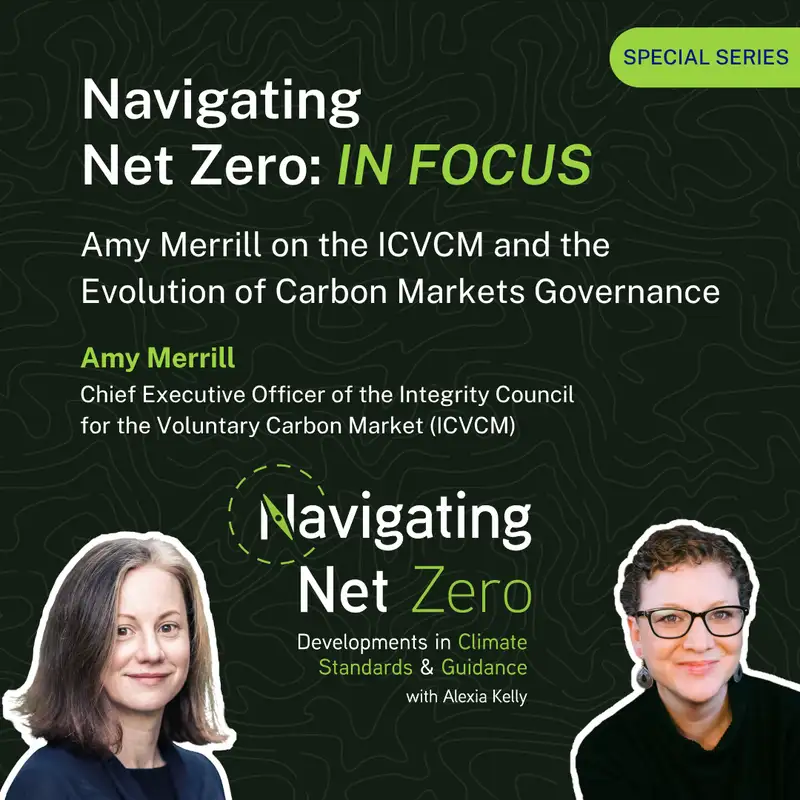
IN FOCUS: Amy Merrill on the ICVCM and the Evolution of Carbon Markets Governance
This transcript has been edited for brevity and clarity.
Alexia Kelly:
Good morning, good afternoon, good evening. This is Alexia Kelly, your host of Navigating Net Zero. Thank you for joining us for this special episode with the incomparable Amy Merrill, CEO of the Integrity Council for the Voluntary Carbon Market—or, as we affectionately call it, the ICVCM.
Amy, thanks so much for joining me on the pod.
Amy Merrill:
It’s a real delight to be here. Any excuse, Alexia, to spend time with you.
Alexia Kelly:
We certainly do get plenty of opportunities to spend time together. In the interest of full disclosure, I sit on the board of the Integrity Council and co-chair our Continuous Improvement Work Program. So Amy and I have the pleasure of working closely together across ICVCM’s efforts around carbon market maturation, evolution, and reform.
Amy is the CEO of ICVCM, the integrity body responsible for setting global quality standards for carbon credits—a much-maligned, very important, and much-beloved topic for me personally and for many of the people we work with.
Before joining the Integrity Council, Amy spent a decade at the UN Climate Change Secretariat, where she helped lead the development of Article 6 of the Paris Agreement and the rules underpinning international carbon markets. She’s a qualified UK lawyer with more than 20 years of experience in carbon markets and climate finance.
Amy, thanks again for joining me.
Amy Merrill:
Thanks.
Alexia Kelly:
So tell me: What is the ICVCM, and why does it matter so much?
Amy Merrill:
The Integrity Council is an independent system for setting a global threshold for what a good carbon credit looks like.
That’s really important because this market grew organically over time. To get to investability—and to deliver scaled mitigation and climate finance—you need a system where different sources of credits can be compared and understood, and where everyone is using best practice. That’s how you build a market people can believe in.
The Integrity Council came into a market that was highly bespoke and had developed largely around buyer preferences and said: “These are the ten things that matter most. Here’s the rule set behind them, and everybody should be assessed against it.”
We’ve now reached the point where much of the market has been assessed, and we have comparable sources of high-integrity carbon credits.
Alexia Kelly:
How many programs have we reviewed? And talk a little about the work you’ve been leading since you joined as CEO.
Amy Merrill:
We’ve now approved 13 programs as CCP-eligible, representing about 96 percent of the independent sources of credits in the market. Sixty-six million unretired credits are now using the CCP label.
We’ve assessed 65 methodologies, 41 of which have passed, across many different categories.
What that means is that both the carbon-crediting program itself has passed our assessment process and the methodologies used to quantify the credits have been assessed.
So it’s a double-tick process, which makes it very rigorous. It’s not a blanket approval of everything a program does.
Alexia Kelly:
I think that causes some confusion in the market. Help people understand the difference between a CCP-eligible program and that second tick—the assessment of specific methodologies.
Amy Merrill:
There are independent standards, registries, and programs—they go by many different names—that set the rules for how carbon credits are issued.
When we assess those programs, we’re looking at governance: how they manage their registries, how they make decisions, how transparent they are, and how they handle stakeholder grievances.
So we’re not simply asking, “Does this methodology have a conservative baseline?” We’re asking whether the entire organizational system—its governance and risk management—is capable of providing this service to the market with integrity.
If programs pass that assessment, they become CCP-eligible. And virtually all of them have had to materially change their rules to get there. We’ve seen a significant increase in standards around transparency, grievance management, and other areas as programs have gone through the process.
Once they’re approved, we continue to monitor them through assurance and oversight processes to make sure they maintain those high-integrity standards.
Then, separately, the methodologies they use to credit individual projects are assessed against other Core Carbon Principles: how they manage reversal risk, how they set conservative baselines, and how they demonstrate additionality—making sure you aren’t crediting something that would have happened anyway.
All of those elements together create what we call the double tick.
Alexia Kelly:
Thanks for that explanation. I want to come back to something you said, because I think it’s really important and perhaps less visible to people who aren’t as deep in the weeds.
By publicly establishing threshold requirements for governance and quality, we’ve seen the market respond organically. When standards come to us for review, they’ve already read those requirements in great detail and begun putting the necessary governance systems in place. By the time they reach the assessment process, they’re much closer to the bar we’ve established than they otherwise would have been.
There’s a lot of pre-market conditioning that happens simply because ICVCM exists.
That’s important because, even as we’re reviewing programs and methodologies, what’s less visible is all the work happening behind the scenes at the standards-body level to meet that market-wide threshold for quality.
I think that’s an important signal of maturation across the entire market. It has helped usher in a new era of reform because standards now have a much clearer understanding of what quality looks like from a global perspective. They can respond and adapt much more consistently than in the past, when everybody essentially had their own version of quality.
Tell me a little more about how ICVCM itself is governed and structured. Because this is a standards-focused series, we’ve been talking a lot about the governance of nonprofit standard setters—why it matters, and how much thought and care goes into designing these systems in the absence of unified government regulation.
How is ICVCM structured, and what do you think is working about that model?
Amy Merrill:
The thoughtful design of the organization is a big part of why ICVCM has been able to earn support from programs and the broader market.
It has an independent governance system. The governing board consists of independent members, representatives of Indigenous Peoples, and some non-voting market representatives. We also have an independent expert panel providing technical and methodological advice.
That creates both independent decision-making and separation between the technical advice and the ultimate decisions.
The rules themselves are modeled in many respects on regulatory frameworks—things like listing rules and intermediary rules. There was a strong regulatory mindset behind their design, not least because our chair, Annette Nazareth, is a former SEC commissioner. The task force that designed the system and ultimately evolved into ICVCM understood the importance of robust, regulatory-style governance.
The executive secretariat supports the operational delivery of that system. But fundamentally, you have an organization that is independent and accountable, with strong conflict-of-interest and disclosure rules.
We also publish decisions and board reports, and provide transparency around our own operations. All of that allows us to stand behind a decision and say, “Yes, this was a robust process.”
Alexia Kelly:
I really appreciate the perspective both you and Annette bring from the regulatory world: making sure we have clear governance processes, that we follow them consistently, and that we’re doing all of the things required of an institution filling a significant governance gap.
As a former government regulator myself—and you were one for many years—I think it’s important to bring those public-sector and good-governance practices into this architecture.
I hope some of this is ultimately interim architecture as we move toward more unified global regulatory systems. But while we’re building it, we need to build it in the best possible way. I think you and Annette have done an amazing job of establishing that as a North Star for ICVCM.
I also want to talk about the Continuous Improvement Work Programs, both because they’re near and dear to my heart and because I think they’re incredibly important to this market.
Carbon markets have had their share of controversy—certainly for as long as either of us has worked in them. And as we align around what good looks like, it has become clear that there’s still a lot of work to do. There’s primary science that still needs to be resolved. Rules need to be updated. We’re getting better data and information all the time.
The Continuous Improvement Work Programs—or CIWPs—weren’t necessarily contemplated at the beginning of ICVCM, but they’ve become an important part of our work. Why do you think they matter?
Amy Merrill:
They’re really important because they embody something that is a hallmark of ICVCM: stakeholder engagement.
They’re big-tent processes. Everybody is around the table. All views and perspectives are allowed and debated.
That makes the Integrity Council different from some other systems. The original rule set went through notice and comment, and now, as we work out where the market needs to go next—what we still need to understand and where important uncertainties remain—we do that through shared discussion and collective examination of the problems.
My background at the UN taught me that when you put all the countries around the table, you’ll get as many views as there are people in the room. But ultimately, at the UN, you get government views. It’s difficult for other stakeholders to be fully incorporated because governments make the decisions.
At the Integrity Council, having everyone at the table and giving them a voice in defining the next level of good allows us to hear critical practical considerations.
What is best practice—and how implementable is it? What if something is theoretically perfect, but only one organization can provide the necessary service and it operates in six countries? How do you set a threshold nobody can actually implement? If we adopt rule X, could it unintentionally cause outcome Y?
You only hear those things when you bring everybody together.
There are many gritty issues in carbon markets—and Alexia, you have many favorite gritty issues to talk about. But as someone who has spent a career working on consensus-building, that’s why these processes matter so much.
They show us where the shared, collective journey toward the next best practice lies—through honest listening, engagement, and debate rather than fighting.
Alexia Kelly:
I completely agree. One of the things that excited me as we were organically developing the Continuous Improvement Work Programs was that the market had never really had a place where the whole market could come together for a structured, well-facilitated discussion about where we needed to go next.
It’s a different approach to standard setting. It allows us to engage the full range of views and make sure we’re hearing from all the key perspectives as we ask: Based on the information we have today, what does good look like? What rules and architecture should we put in place? And how should those evolve over time?
“Continuous Improvement Work Program” isn’t a particularly sexy name, but we kept it because continuous improvement is fundamental both to ICVCM’s role and to how environmental standard setters need to approach their jobs.
In many cases, we’re doing this for the first time. Nobody has done it before.
As a policymaker, you make the best decision you can with the information available. Historically, standard setters have had to do the same, often without enough primary data to answer very specific questions—like the appropriate methane oxidation rate for a landfill with a pervious versus impervious cover, something we have debated for many hours.
So we make the best standard we can with the information we have. We recognize it won’t be perfect. And then we continuously improve it as the science, data, and market evolve.
That process is incredibly important.
Amy Merrill:
In 2023, we published the Assessment Framework—with roughly 200 rules—alongside the Core Carbon Principles. Programs began applying, and we convened stakeholders to sort methodologies and assess them against key criteria.
Now, with three years of experience, we understand much better where the market has moved since 2023. We’ve learned from the Continuous Improvement Work Programs and from work happening outside ICVCM about what the next level of good looks like. And we understand where we can strengthen, deepen, and clarify the rules that the market has now aligned around.
This year we introduced another excitingly named concept: the “Rule Architecture.” It gives us a system for evolving the rule base over time—interpreting and clarifying it, explaining it, and updating parameters where necessary.
All of that is subject to best-practice public consultation, impact assessment, and appropriate grace periods—the elements of a sound regulatory system. So we now have an Assessment Framework that can deepen and evolve as the market grows and strengthens, ensuring that this market we can believe in today can continue to be believed in over time.
Three years ago, everybody was still reading through the Assessment Framework and asking, “What does this mean for us?” Now methodologies are being designed, projects are being developed, and financing is being routed toward a system the broader community has adopted because stakeholders have a way to engage in it.
That continuous-improvement piece is important. Because you have a voice at the table, you can understand the journey that leads to a new or revised rule. That ability to engage people so they understand the collective journey we’re on is fundamental to our work and to how we continue pushing the framework to deliver greater market integrity and impact over time.
Alexia Kelly:
I completely agree. I want to talk about the somewhat gray space the Integrity Council occupies, especially as it relates to emerging compliance and regulatory systems.
Obviously, we have many former UN negotiators and regulators on the ICVCM staff and secretariat, and there’s finally a lot happening on Article 6. Praise the Lord. Nobody thought it was going to take this long, but here we are.
How is ICVCM engaging with emerging compliance and regulatory programs, and how are you seeing the convergence between voluntary and compliance markets evolve?
Amy Merrill:
As countries begin to understand how they’re going to implement their Nationally Determined Contributions—their NDCs—and develop their domestic policy mix, they’re recognizing that they can engage with carbon markets in several different ways.
Article 6 created several instruments. One is a central mechanism, now called the Paris Agreement Crediting Mechanism, which is itself what we would call a crediting program. Another is the system of Cooperative Approaches under Article 6.2, where two countries can agree to transact the outcomes of mitigation action—the uniquely named ITMOs, or internationally transferred mitigation outcomes.
What we’re seeing at ICVCM is that countries recognize they can use the CCPs as part of their Article 6.2 transactions, subject to the accounting requirements of the Paris system. They can also use the same standard as a domestic policy lever to encourage corporate action.
What we’re really trying to do is create greater interconnectivity in the carbon market—a clear ability to incentivize action without being overly specific about the eventual use case of any individual credit.
That matters on both sides of the transaction. Sellers need routes to market. If they’re going to develop a project, they need confidence that they can get that credit to a buyer who wants it. The more you create a system where multiple buyers can use the same type of high-integrity credit, the more interconnectivity and interoperability you create.
At the same time, countries can use the CCPs as a policy lever in different ways. They could say to companies, for example, “You can surrender this CCP-labelled credit against a carbon tax,” and then account for that mitigation toward the country’s NDC.
That creates connectivity between domestic compliance programs, international market price signals, Article 6.2, and independent supplies of high-integrity carbon credits.
For me, having spent so much time at the UN, making sure all of these systems stack together is a fundamental responsibility if we’re collectively trying to deliver on the Paris goals.
And we’re already seeing significant uptake. The African Union has said buyers should use CCP-approved credits. We’ve seen engagement from Japan, Malaysia, Singapore, Peru, Brazil, the UK and France, as well as the Coalition to Grow Carbon Markets. Singapore in particular has issued draft guidance in this area.
Alexia Kelly:
That’s fantastic. I think this idea of voluntary carbon markets informing emerging regulatory and compliance regimes has always been core to their DNA.
A lot of people are dismissive of voluntary action and voluntary carbon markets, which I understand. It isn’t required. Particularly on the buy side, we’re essentially asking companies, in good faith, to spend money they otherwise wouldn’t have to spend. That’s a significant ask in an economic system that generally doesn’t reward diverting profits from shareholders.
But think about California as it developed its cap-and-trade program. It anchored its system in work nonprofits had already done around carbon-market standard setting. It looked at those standards and methodologies, made adjustments necessary for compliance under AB 32, and built from there.
That underlying architecture is fundamental, and building it is not a small undertaking. But it is fungible. If we build it well and to internationally agreed standards, it becomes much easier for countries and companies to participate.
There’s also an opportunity for harmonization in voluntary markets that is much more difficult for the UN to deliver.
As a former Article 6 negotiator, I spent a lot of time negotiating how detailed the international rules governing NDC implementation and ITMO use should be. Countries were only willing to give up so much sovereignty to the UN. They wanted flexibility over fundamental domestic policy decisions.
So I see a huge role for ICVCM in helping build that bridge: creating a global, uniform quality threshold as we transition from a largely voluntary world toward, hopefully, a more regulated and coherent set of international systems that can speak to one another.
I know you’ve also done quite a bit of work on market infrastructure development. Say a little about that piece of the puzzle and how it’s evolving out of the Continuous Improvement Work Program that recently concluded.
Amy Merrill:
We did a lot of work looking at the systems that will be needed in a scaled carbon market.
One of the key areas is how registry systems need to evolve. Registries are incredibly technical tools. Depending on the system, they’re used to enable contracting, manage risk, prove title, and deal with reversals.
In a scaled market—with more derivatives, exchange transactions, options, futures, and so forth—those systems need to evolve.
We’re trying to understand what it would take to enable efficient transactions of high-integrity credits. We’ve solved for the integrity of the credit. Now we need to build a market that itself operates with integrity and without unnecessary friction.
That’s how you unlock finance, which is one of the fundamental purposes of carbon markets alongside mitigation. You can have a perfect credit, but if you can’t unlock the finance, you aren’t going to meet the Paris goals or meaningfully address the climate crisis.
So the infrastructure matters. You need to make the market investable and relatively simple while building on the significant investment and infrastructure that already exist.
The same issues arise at the government level. How do countries manage their registries? How do national accounting systems under Paris coordinate with registries operated by independent actors? And how do we reach a point of real interoperability and transparency across all of those systems?
That’s one of the areas we’ll continue working on over the coming year.
Alexia Kelly:
That essential climate infrastructure is so important. In some ways, carbon markets are 15 years ahead of many of the conversations happening now around greenhouse gas accounting, simply because we’ve been doing this for so long.
The architecture we built under the UN and subsequently through voluntary standard setting offers hard-won lessons about what works and what doesn’t.
The fact that most major crediting programs are now CCP-eligible is also a significant indicator that much of that core infrastructure is in place. What we need to do now is begin scaling it.
So let’s talk about use cases and demand. With Article 6 coming online under Paris, countries are free to participate in international trading to support implementation of their NDCs. Countries themselves determine how much international mitigation they want to use versus how much they source domestically.
Similarly, many developing countries see carbon markets as a core part of mobilizing climate finance.
Talk a little about both emerging compliance demand and how you see voluntary demand evolving.
Amy Merrill:
I think we face many of the same questions in both markets. And I don’t think it’s sufficiently understood in the corporate accounting world how we’ve already tried to solve some of these issues through Article 6.
Sometimes I hear these conversations and think, “We had that conversation for ten years.”
When you’re crediting something, you decide how to measure it, and that measurement becomes a transactable asset. That’s the key distinction.
When you decide what constitutes a high-integrity credit, you’re making a consequential decision about how something is accounted for and counted. In other systems, where you’re simply measuring emissions, you want to measure as accurately as possible, but the consequence of that measurement isn’t itself the creation of a market asset.
When we think about compliance and voluntary markets, we’ve already wrestled with questions like: How do you model where you expect to be several years from now? How do you transparently establish a trajectory toward that point? And how do you ensure that using carbon markets doesn’t undermine your own ability to reach your target?
Those are the same debates that arise when we consider the role of carbon credits in corporate decarbonization.
Should companies be able to use carbon credits to avoid implementing their own targets? Under the UN rules, you have to transparently demonstrate that the way you’re using carbon markets is consistent with reaching your target. The rules don’t necessarily prescribe exactly how you do that, but you have to show your approach, and it is subject to review.
At the corporate level, we’re asking similar questions. As companies decide where to put their money and what they can and cannot mitigate, where can carbon credits support action that is consistent with the company’s overall decarbonization pathway?
Alexia Kelly:
I think that’s an incredibly important question, and obviously somewhat existential for the future of the market.
As the Science Based Targets initiative gets clearer about its rules, and as the ISO Net Zero Standard develops, there has been a very heated—and frankly sometimes pretty ugly—debate about what role carbon credits should or should not play.
I’m hoping we can get to a place where we depoliticize this somewhat.
I always joke that carbon markets aren’t the worst; they just went first.
They were the first time we tried to build a global governance architecture around the almost infinite range of mitigation actions companies could take. There is an enormous universe of opportunities to reduce emissions across sectors and sources.
The process of building and implementing this market has been variably successful. The crises of three or four years ago illuminated many areas where we clearly needed to do better. ICVCM’s response has helped address the threshold-quality question.
I agree that we’ve made enormous progress on supply quality. But now we need to move beyond a logjam where there seems to be a perception that if a mitigation action appears inside your reported greenhouse gas inventory, it’s wonderful and we don’t need to worry much about the accounting; but if it happens outside your inventory, it’s “greenwashing garbage.”
That’s almost the opposite of what we need if we want to solve this problem cost-effectively.
The system we’re currently building in the voluntary space is significantly more expensive, cumbersome, and difficult to implement than what countries agreed to under Paris. That seems a little crazy to me.
Amy Merrill:
I see two things we need to solve.
First, at the corporate level, action has to be easier than inaction.
Right now, the incentives don’t line up. It’s often harder to do something because you’ll be scrutinized for whatever you do. And we know the regulatory capacity of governments is significantly constrained in the current geopolitical environment.
So we have to find ways to make doing something better than doing nothing.
I think we’re seeing movement on that across the ecosystem—the alphabet soup, or whatever we want to call it. SBTi referring to ICVCM in its strategy reflects recognition that we all need to work together to create incentives for action in the absence of regulation.
The second point is that there will always be different views about how something should be done. At the international level, we dealt with that diversity by recognizing that more than one view could be legitimate.
The world is a very diverse place.
People may not know this, but the Paris implementing decisions even contemplate non-greenhouse-gas ITMOs, because some countries said they didn’t want to measure everything in tonnes but still wanted to use cooperative approaches to manage their emissions.
Sometimes it comes down to a willingness to find the shared journey, build something together, and break down barriers to communication.
There can be many different routes to the same destination. Every company has a different situation. Every country has a different situation.
One thing we can collectively do in the next phase is recognize that there are multiple ways to get companies to act with high integrity on decarbonization.
Alexia Kelly:
I always joke that I’m entirely agnostic about the source of the mitigation outcome, as long as it’s real.
If something is measurably reducing or removing emissions, I want it in the mix as part of a portfolio of action.
And personally, I still really care about cost. Cost matters. We’re designing standards as though cost shouldn’t even be a consideration, which I think is a recipe for disaster—especially when we’re asking companies to go from zero to 100 overnight.
We’ve seen this repeatedly in domestic compliance systems. When you’re trying to put a price on carbon for the first time, if you come out of the gate with a price that’s too high, you can get political revolt. If people have the ability to walk away, they often will.
We’ve seen rules repealed. By contrast, RGGI, the EU ETS, and California’s emissions trading system all began with relatively loose caps and relatively low compliance prices. That was the political price necessary to build enough consensus to establish the regulation.
So the idea that every company should immediately be limited to investing only in the most expensive, hardest-to-source, deepest supply-chain decarbonization technologies feels like we’re setting ourselves up for failure.
How do we reintroduce the idea that we should strategically incentivize investment in the lowest-cost, highest-quality mitigation available, regardless of where it sits in a company’s supply chain or around the world?
Amy Merrill:
It’s a really good question.
I think one misunderstanding is that high integrity and high price are necessarily the same thing. They aren’t.
What we’ve demonstrated at the Integrity Council is that you can look across different types of mitigation and establish comparability by identifying credits that meet a high-integrity threshold.
Those credits will have different price points. The integrity label tells you they’re investable. It doesn’t mean you should simply buy the most expensive credit.
There’s another dimension of carbon markets that we haven’t talked about much today: carbon finance.
Why do carbon markets exist? They entered the international system under the Kyoto Protocol to deliver mitigation and sustainable development.
Carbon finance can generate revenue that supports livelihoods, food security, energy affordability, and energy access. So there’s an entire dimension that isn’t solely about the mitigation outcome.
Across carbon-market methodologies, different activities are addressing different needs. Some respond directly to development needs. Clean cookstoves, for example, can address indoor air pollution. Surely clean air should be a basic right.
Others are addressing the cost of deploying new technology or the cost of capital needed to bring that technology to scale.
When we talk about price, we can get confused about what a particular methodology is actually trying to solve for. Is it a development goal? Is it a cost-of-capital problem? Is it technology deployment?
The integrity question is different. Integrity is about transparency, calculation, third-party verification, and the other safeguards that apply whether you’re talking about an expensive technological removal or a clean-cookstove project trying to reach as many households as possible.
We get muddled when we assume all of these activities are trying to do the same thing.
It’s okay to have a diversity of methodologies doing different things.
I always think of carbon markets as trying to plant two trees with one seed: finance and mitigation.
Alexia Kelly:
Absolutely.
You’ve raised two important issues I want to come back to, particularly social safeguards.
But first, I want to underscore the point you just made. What carbon markets actually do is establish rules that can be applied across very different project types so that the output at the other end—the mitigation outcome—is fungible and comparable: one metric tonne of CO2e reduced, avoided, or removed.
Then there are all of the other critically important dimensions embedded in those projects and methodologies.
One area where I think ICVCM has made a particularly important contribution is social safeguards and raising the bar for what it means to have a genuinely participatory market.
When I started my career in this space, most standards addressed social safeguards with language like “do no harm” or “do no net harm.” That was basically all we had. It was enormously open to interpretation, and I don’t think anyone quite knew how to operationalize it.
ICVCM has done a huge amount of work here. How has the Integrity Council raised the bar on social safeguards for local communities? And what is the Indigenous Peoples and Local Communities Engagement Forum? How does it work, and how does it feed into ICVCM’s governance?
Amy Merrill:
I think this was a stretch assignment for the market in 2023, and everybody knew it.
We were essentially saying: These aren’t co-benefits. They’re core benefits. They matter, and they have to be done right.
The Assessment Framework explicitly said, more than in many of our other rules, “Here’s the starting point—but expect more to come.” It signposted that the market would need to keep raising the bar.
That includes environmental harm: understanding, measuring, and mitigating impacts around pollution and biodiversity. It also includes the social impacts of projects—positive and negative—on local communities, land acquisition and land rights, and ensuring that free, prior and informed consent is properly implemented in the context of Indigenous Peoples.
It remains a work in progress.
The Continuous Improvement Work Program identified areas where we should strengthen the rules further. And the self-led Indigenous Peoples and Local Communities Engagement Forum—which is hosted by the Integrity Council but conducts its own policy work—is examining questions such as what best practice in benefit sharing looks like.
What does it mean to disclose a benefit? What constitutes good benefit sharing in practical terms?
We’re also working toward a system that values traditional ecological knowledge alongside more conventional Western scientific approaches to questions such as conservative baseline setting.
By making these issues a Core Carbon Principle, we’ve made it impossible for anyone to say, “That doesn’t matter for my project type.”
It matters for every project type because human rights are a central concern and should be treated that way.
We’ve also learned from carbon markets that when human rights aren’t treated as a central issue, things go wrong—as they do in other sectors.
For me, one of the most important things we’re doing is listening to people who actually know these issues and bringing real experience and expertise into the work. That will help us continue to interpret and strengthen the rules in the years ahead.
Alexia Kelly:
Absolutely. I’m continually amazed by how difficult it is to be a regulator. Benefit sharing is a good example of an issue that sounds relatively simple and straightforward but, in practice, absolutely is not.
You hear people say, “Benefit-sharing arrangements should be public and transparent.” On its face, that seems entirely reasonable.
But in consultations I participated in with local communities as part of another project—not a formal ICVCM process—we heard something very different.
Communities told us: “Please don’t do that. If you publicly disclose how much money we’re receiving, the cartel will know, and they’ll come and take it.”
What they actually needed was a separate mechanism to manage and safeguard that money. They needed a collective process for deciding how it would be invested, but they did not necessarily want the money flowing directly into the community because doing so could put families in danger.
That was one of those moments where you realize: I never would have known that if we hadn’t had the conversation.
When you’re sitting where we sit, you often don't have that on-the-ground perspective and experience. Building those voices into the process is therefore essential.
The answer isn’t always as obvious as it’s sometimes characterized. Finding the right balance is one of the hardest—and most interesting—parts of this work.
One of the things that’s striking right now is just how many different organizations are involved in setting standards and rules across this ecosystem. We have GHG Protocol, SBTi, ISO, ICVCM, VCMI, and others. And for companies, it can be genuinely difficult to understand how all of these pieces fit together.
How do you think about ICVCM’s role within that broader landscape? And how do we get to a place where these different systems are complementary rather than creating additional complexity for companies trying to act?
Amy Merrill:
I think that’s exactly the challenge we need to solve.
Each of these organizations has a different role. At the Integrity Council, our job is to answer a relatively specific question: What constitutes a high-integrity carbon credit?
That’s what the Core Carbon Principles and the Assessment Framework are designed to do. We assess crediting programs and methodologies against a common threshold so buyers, governments, investors, and others can have confidence in the integrity of the credits they’re using.
But that doesn’t answer every question.
It doesn’t tell a company what its emissions inventory should look like. It doesn’t tell a company what target it should set. And it doesn’t necessarily tell a company how it should use carbon credits as part of its broader climate strategy.
Those are questions that other organizations are working to answer.
So I think the opportunity is to make those systems fit together much more clearly. If a company is going to use carbon credits, there shouldn’t be five different answers to the question of what constitutes a high-quality credit.
That’s where we can provide a common foundation.
Then other standards can answer questions about how those credits should be used in different contexts.
Alexia Kelly:
I think that distinction is incredibly important because we tend to collapse all of these questions into one enormous debate about whether carbon credits are “good” or “bad.”
But there are actually several different questions embedded in that.
Is the underlying mitigation real? Is it additional? Is it conservatively quantified? Are there appropriate safeguards? Is the credit properly tracked and accounted for?
Those are fundamentally supply-quality questions.
Then there’s a separate question about what a company should do with that credit. Does it count toward a target? Does it sit outside the inventory? Is it reported as a contribution? What does the company say publicly about it?
Those are different governance and accounting questions.
And I think one of the things we desperately need right now is to stop relitigating every question every time we touch one part of the system.
Amy Merrill:
Exactly.
And that’s why alignment is so important.
We have spent years building expertise in these different institutions. We shouldn’t duplicate that work unnecessarily. We should be asking: Where does the expertise sit? Who is best positioned to answer each question? And then how do we make those answers interoperable?
From a company’s perspective, this needs to become much simpler.
If we want companies to act, they need to be able to understand what good looks like. They need confidence that if they follow the rules today, those actions aren’t suddenly going to be characterized as unacceptable tomorrow.
That doesn’t mean standards shouldn’t improve. Of course they should. We’ve talked throughout this conversation about continuous improvement.
But there needs to be a pathway companies can actually follow.
Alexia Kelly:
And I think that gets back to something you said earlier: action has to be easier than inaction.
Right now, in some ways, we’ve created the opposite incentive.
A company that does nothing can often stay relatively quiet. A company that spends millions of dollars trying to do something gets scrutinized from every possible direction.
That’s not a recipe for scaling voluntary action.
We absolutely need accountability. We absolutely need transparency. We need quality thresholds. But we also have to create a system in which companies can understand the rules and participate without feeling like every step they take creates a new source of reputational risk.
Amy Merrill:
Yes. And that’s why I think the work happening across these organizations right now is so important.
There’s increasing recognition that none of us can solve this independently.
We need credible greenhouse gas accounting. We need credible target setting. We need high-integrity carbon credits. We need clear rules around how those credits are used and communicated. And we need all of those pieces to work together.
Ultimately, companies shouldn’t need to become experts in the institutional architecture of the climate standards ecosystem just to figure out how to take action.
Our job should be to make that architecture work for them.
Alexia Kelly:
That’s a very good segue to my final question.
You and I have both spent a substantial portion of our careers working on carbon markets. And these markets have obviously been through some very difficult periods.
There have been real problems. There have been legitimate criticisms. There have also been criticisms that I think have sometimes painted with an extraordinarily broad brush.
And yet both of us are still here.
So after everything you’ve seen—from Kyoto and Article 6 through the voluntary market and now the Integrity Council—why do you still believe carbon markets matter?
What keeps you doing this work?
Amy Merrill:
For me, it comes back to the scale of the problem we’re trying to solve.
We need an enormous amount of mitigation, and we need an enormous amount of finance to make that mitigation happen.
Carbon markets are one tool for connecting those two things. They are not the only tool. They were never supposed to be the only tool. But they can channel finance toward mitigation opportunities that otherwise may not happen. And they can do that across borders. That matters enormously.
There are places in the world where the opportunities to reduce emissions, protect forests, deploy clean technologies, improve livelihoods, or remove carbon are significant—but access to capital is constrained.
Carbon finance can help bridge that gap.
And if we can do it with integrity—if the mitigation is real, if the accounting is credible, if communities are respected and benefit, and if the system is transparent—then I think it would be a profound mistake to walk away from that tool.
Alexia Kelly:
I completely agree.
I think sometimes we lose sight of the underlying reason these systems were created in the first place.
Climate change is fundamentally a global collective-action problem. A tonne of carbon reduced in one place has the same atmospheric value as a tonne reduced somewhere else.
At the same time, the cost of reducing that tonne can vary enormously.
Markets give us a mechanism for connecting capital with mitigation—to find opportunities where money can actually unlock action and to move resources toward them.
And particularly when we think about the extraordinary climate-finance gap in developing countries, I just don’t see how we solve this problem without figuring out how to mobilize private capital at a much larger scale.
Amy Merrill:
Exactly.
And I think we should be ambitious about what the market can become rather than allowing the problems of the past to define its future.
We have learned an enormous amount.
We know more about additionality. We know more about permanence. We know more about quantification. We know more about safeguards and Indigenous Peoples and local communities. We know more about registries and transparency.
We should use those lessons.
The response to finding weaknesses in a system shouldn’t necessarily be to abandon the system. It should be to fix those weaknesses and build something better.
That’s what I find exciting about this moment.
We now have an opportunity to take decades of experience and build a market that is more credible, more transparent, more interconnected, and ultimately capable of delivering much more climate impact.
Alexia Kelly:
I love that.
And I think that’s a perfect place to end because that really is the theme of this podcast: what’s working, what’s not, and what’s next.
The carbon markets have given us plenty of examples of all three.
But I share your optimism. We’ve learned a tremendous amount over the last 20-plus years. We’ve built infrastructure that simply did not exist when we started. And we now have an opportunity to take those lessons and build systems that are more functional, more rigorous, more equitable, and more capable of operating at the scale the climate crisis requires.
Amy, thank you so much for joining me. And thank you for all the work you and the team at the Integrity Council are doing.
Amy Merrill:
Thank you, Alexia. It’s been such a pleasure.
Alexia Kelly:
Thanks, everyone, for joining us. We’ll see you next time on Navigating Net Zero.
Creators and Guests