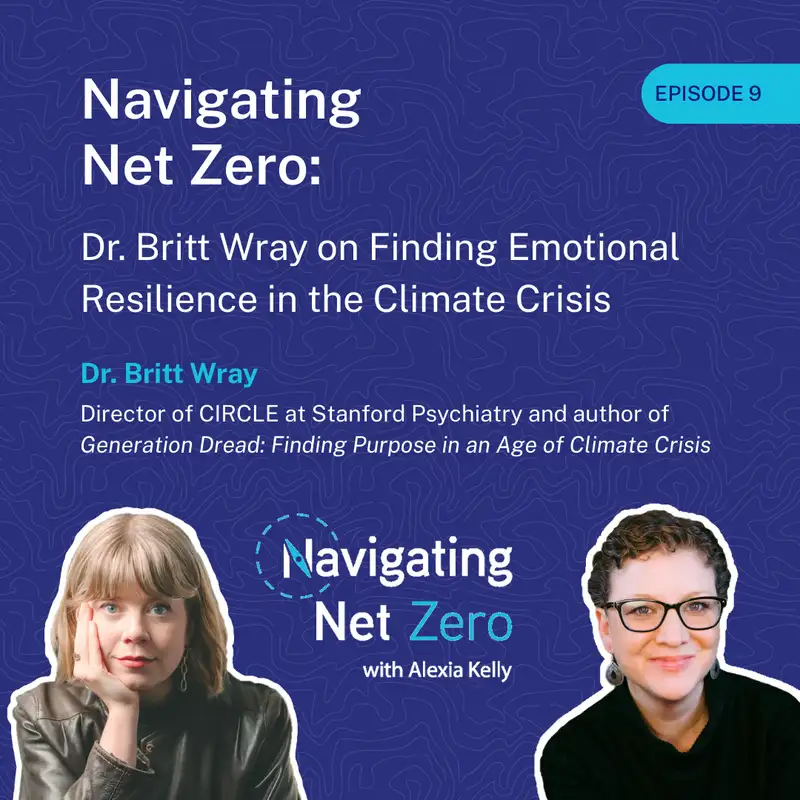
Navigating Net Zero: Dr. Britt Wray on Finding Emotional Resilience in the Climate Crisis
Navigating Net Zero — Episode 9, Season 1
Guest: Dr. Britt Wray (Psychologist; Author, Generation Dread: Finding Purpose in an Age of Climate Crisis)
Host: Alexia Kelly
Transcript edited for clarity and readability
Alexia Kelly
Good afternoon, evening, or morning—wherever you may be. Welcome back to another episode of Navigating Net Zero, where we explore what’s working, what’s not, and what’s next as the global economy transitions during this incredibly important time.
As part of our series of book conversations—talking with authors who have written about the climate crisis from a range of angles, including solutions and how we respond—I’m absolutely delighted to be here today with Dr. Britt Wray.
Dr. Wray directs CIRCLE at Stanford, where she leads cutting-edge work on climate resilience and mental health. She’s a leading voice on climate anxiety; the author of Generation Dread, which we’ll be discussing today; and a trusted communicator helping people navigate the emotional side of the climate crisis. She’s also the author of Rise of the Necrofauna: The Science, Ethics, and Risks of De-Extinction, published in 2017 and named a Best Book of the Year by The New Yorker. She holds a PhD in Science Communication from the University of Copenhagen, has hosted science radio, podcasts, and television programs for international broadcasters including the BBC and CBC, and has spoken at TED and the World Economic Forum.
In addition, she’s the founder of Gen Dread—gendread.substack.com—a newsletter about building courage and taking meaningful action on the far side of climate grief.
Dr. Wray, I’m a big admirer of your work. Generation Dread in particular was really helpful to me. Thanks so much for joining me here on Navigating Net Zero.
Dr. Britt Wray
Thank you so much for having me, Alexia. It’s great to be with you.
Alexia Kelly
It’s funny—preparing for this conversation, I realized I’m what I would call maybe not Generation 1.0, but 2.0 of environmental activists. I grew up in the eighties. I’m a millennial. I started my career almost 20 years ago, and back then we didn’t really talk about our feelings related to climate change. There wasn’t much space—or recognition—that working on this issue can be challenging emotionally, psychologically, even spiritually.
When your book came out—and a few others in the last five years—it kind of blew my mind that all of a sudden it was okay to say out loud: this is incredibly hard. We’re at a pivotal moment historically, politically, environmentally, culturally. Every generation has its challenges, but this generation is navigating a very intense stew of crises—arguably even more so now than when your book first came out.
So, tell us a little bit about how you came to write the book—and why you’ve focused your career on this set of issues.
Dr. Britt Wray
Thank you for that set of questions. It’s a great way to begin. And it sounds like we’re in the same realm of millennialhood—relating to the climate, biodiversity, and ecological crisis over time, with shifting norms around the emotional and psychological impacts.
I’m glad to hear you say that my book—and a few others published since 2022—have helped make it okay to talk about the psychological strain that comes with professionally or passionately paying attention to planetary crisis. If you devote your life to this—whether you’re a climate scientist, environmental journalist, green policymaker, activist—it’s commonplace, appropriate, and normal to cycle through waves of difficult emotions that follow from awareness and confrontation of these interconnected predicaments.
I’ve always seen my job—writing the book, and being a science storyteller at the intersection of climate change and mental health—as helping to create new norms so we can finally have these conversations we haven’t been having for far too long.
For years, communication about climate followed what’s often called the “deficit model”—the idea that if we just provide enough good information and scientific evidence, the public will act responsibly in its own interest, and power-holders will too. But we know that isn’t how it works. People filter information through biases, values, and personal predilections. Two people can look at the same dataset and walk away with completely different beliefs, depending on what they value.
There’s also been an allergy—especially in dominant Western culture—to bringing emotion, psychosocial realities, and spirituality into “hard” issues that are assumed to be addressed with tech, science, policy, and finance. Everything else is treated as noise—sometimes feminized and discarded. Many scientists are trained to protect objectivity so strongly that they deny the other parts of their humanity—the fact that they might feel something about what they discover.
So, part of why there are new cultural waves and permissions to talk about despair, overwhelm, grief, sorrow, anxiety, and fear is simply that the problems have reached such a fever pitch that individuals and communities can’t keep it all contained anymore. We need each other. We need spaces to support and validate what’s moving through millions of people, because we’re dealing with a collectively traumatic situation.
And without processing what it means to appreciate, understand, and confront climate hazards and impacts, we cut off a crucial part of the human response. At its core, the climate crisis is a human behavioral crisis—a relationship crisis: our relationship to each other, to the Earth, and to the more-than-human world.
If we only look for answers through finance and technology and policy and science, and we don’t bring in behavioralists, psychologists, and wisdom holders—people who tend to relationality—we’re missing a crucial key to accelerated success in moving toward solutions. So this is a wave that has become more central only in recent years: recognizing that we need “inner development” skills to match the outer change we’re trying to achieve.
Alexia Kelly
I want to come back to that. One thing that has struck me, looking back over the last 20 or 30 years of environmental activism: we’ve made important headway in some areas, but largely we’ve been unsuccessful at dramatically reducing global emissions and curbing the crisis. As you said, the doctrinal view has been technocratic—“If we just explain it better, then everyone will understand and act.”
Integrating the spiritual, psychological, physiological—the interconnected approach you’re describing—feels fundamentally different from how many of us were trained. I have a master’s in public administration. It was very much systems change as a technocratic exercise—power and influence—much less what we might call “hearts and minds” work.
And especially as women, many of us have been told that success means being very science-focused: “Just the facts.” Don’t be emotional. Stick to the technocratic script. For me, it can feel uncomfortable to break out of that.
So what does this look like in practice? For mid-career professionals in the middle space—how do you recommend we integrate these considerations and take action in a more holistic way?
Dr. Britt Wray
That’s a beautiful question—and I really sympathize. I was trained in those ways too, and I absorbed those lessons from culture, family, and institutions. But it comes at a cost.
If we define insanity as trying the same thing again and again without getting the results we want, then we have to ask whether something about the way we’re addressing the problem is part of the problem. We can’t continue to rely only on tools that come from histories of separation—Cartesian dualism, certain forms of scientific knowledge production that privilege empiricism over other dimensions that can’t always be pinned down, scaled, or measured.
When you truly face, with both eyes open, that planetary life support systems are destabilizing—and that we’re moving outside the safe operating space for humanity—existential distress is a natural response. There’s nothing pathological about having existential emotions in response to what climate science is telling us. It’s a sign of care, concern, and attachment to reality. We hurt because we care and love.
Opening to the full truth—on the heart and body level—can be liberating and adaptive. It can enhance conviction, courage, and love-driven action. The psychoanalyst Sherry Nicholson Weber has said that core work in a time of ecological breakdown is the work of mourning. There’s something alchemical about allowing yourself to open your heart to what’s being lost, threatened, and anticipated.
Grief isn’t just difficult emotion—it’s also a process that shows us how the world is changing and how we might show up within that changed world. It’s been said: grief is the cost of attachment. Grief is the price we pay for love.
Alexia Kelly
I love that sentiment. In the book, you write that grief can be a teacher—a pathway to purpose. What does that transformation look like in practice?
Dr. Britt Wray
If you allow yourself to feel the depth of grief, the process teaches you things. It changes you. It opens something within your spirit, psyche, your sense of meaning. It becomes a navigational tool—helping you set direction as you relearn the world.
If you don’t shun grief away, it can brush distractions aside and bring you into the big existential questions. That can help you unfold toward purpose. There’s no single formula—people move through grief differently.
We often reference Kübler-Ross—denial, anger, bargaining, depression, acceptance—originally developed around terminal illness and later adapted to other forms of grief. But climate grief is different. It doesn’t have the finitude of a single loss with a clear endpoint. It’s ongoing and nonlinear. Still, as people sit with it and face what’s being lost, they can reach forms of acceptance—an acknowledgment of how the world is different—and then ask: who am I going to be in this? What meaning will I make? What purpose will guide me?
That process can help reinvest the energy that gets drained by stress and sorrow into meaningful action—things that make you feel more alive and bring value to others. There’s a dynamic “payout,” so to speak, from metabolizing grief rather than avoiding it.
This connects to non-dual perspectives—the Buddhist idea of “no mud, no lotus.” Joy and suffering coexist. Both are part of being alive. We learn to dance with them. And while it can feel scary when we haven’t been taught that, it’s actually deeply natural and enduring for our species.
Alexia Kelly
As you were talking, it struck me—climate grief can feel abstract, especially earlier in my career. Now, the bad news is almost omnipresent, especially if you work in this field.
And thinking about my own experience with grief: I lost my mom this year to cancer. It was fast, traumatic, and I’ve been learning what it means for grief to live with you all the time. It feels, in some ways, like part of the deal in this job too.
I’ve been trying to see grief as a companion—something you can’t outrun. Minimizing it doesn’t work. But you also have to function.
In the book you talk about the Good Grief Network, which I loved—especially their framing: seeking “the delicate balance between unrealistic optimism and angry nihilism.” That’s such a beautiful encapsulation of what it means to be a climate professional.
Is the Good Grief Network a resource people can access? And can you share a bit about your experience with it, and any insights you have about learning to live with grief?
Dr. Britt Wray
I’m so glad you asked about them. I’m grateful for what they’ve created. The framing you mentioned—walking the tightrope between polarities—is exactly the work: holding multiple truths without getting stuck too long in any one place.
We humans often want a single story and a uniform answer. We can struggle with cognitive dissonance—holding opposing thoughts at once. But reality demands that we be capacious enough to hold what scares and frustrates us, and what sustains our commitment.
When climate emotions arise, people can get knocked off balance and cling to one side. Sometimes people who express difficult emotions get labeled “doomers.” In some cases, that label may fit—if someone is narratively foreclosing the future, insisting the die is cast and nothing matters. But often it doesn’t fit. It’s not “doom” to name how bad things are. Some of the most ruggedly optimistic people are those who see the darkness clearly and still act.
One quote that captures this: “I’m a pessimist because of intellect, but an optimist because of will.” Another: “I’m not an optimist or a pessimist. I’m a possibilist.”
The Good Grief Network makes room for nuance. They allow people to talk about grief in community and also to cultivate attention to opportunities for action and meaning. That balance is important because in peer-support spaces there’s always a risk of trauma dumping—stories that leave others feeling hopeless. Their values guide the space toward both honesty and possibility.
They created a 10-step peer-support program for climate grief modeled after Alcoholics Anonymous. The founders, who grew up with Al-Anon, understood the power of what happens in those rooms and adapted it for overwhelming climate emotions.
Participants often meet online (sometimes in-person), moving through weekly themes. Witnessing others can be emancipatory—it helps people feel less alone and validated. Many people can’t have these conversations easily with friends or family; despite polling that shows people care, there’s still a damaging spiral of silence around climate topics.
The program has now been used in over two dozen countries. They have a train-the-trainer model so anyone can become a facilitator and run a circle. They’ve also created spinoffs for parents and for youth.
They’re not the only resource, but they were early, and they’re heavily influenced by Joanna Macy and “The Work That Reconnects”—a set of practices for honoring gratitude and pain, witnessing each other’s stories, and emerging changed, with new eyes and renewed commitment. Joanna Macy passed within the last year, and her influence is all over what the Good Grief Network does.
Alexia Kelly
That’s incredibly helpful and encouraging. One thing climate professionals struggle with—my last job at Netflix was the first time I worked with non-sustainability professionals in almost 20 years—and it was eye-opening. I assumed most people eat, sleep, and breathe climate the way we do.
Instead, I felt—for the first time in my life—like the “crazy lady in the corner” shouting that the sky is falling, while others looked at me like, “What are you talking about? What matters is ad revenue.”
That cognitive dissonance feels very real. And now it seems increasingly clear that there won’t be a moment where everyone suddenly understands and we respond coherently. Things will get incrementally worse, and we’ll be adapting and responding in real time.
So I’d love to talk for a minute about parenting. I have an eight- and a ten-year-old, and we’re having pretty sophisticated conversations—especially with my ten-year-old—about what this means. I’ve been trying to balance a kind of Zen acceptance without complacency. Kids take their cues from us. So we try to communicate: yes, this is serious and it will affect you—and you also have agency.
How do you think about “internal” versus “external” activism in the context of parenting? How do we connect those dots so we can show our kids the way without raising them with even more anxiety and trauma than they’re already navigating?
Dr. Britt Wray
You’re describing a really great approach—one that climate-aware parents need to practice.
The research shows the climate crisis is the number one threat to public health this century. The World Health Organization and many other bodies have made this clear. Children and young people will bear the brunt of impacts—and already are.
As parents, our duty is to orient our lives around our kids’ safety and wellbeing, and climate is a major factor in that. But you’re right: it’s not enough to talk only about fear and the emotional atmosphere. The brain tends to be like Velcro for negative information and Teflon for positive information, so we need to buffer difficult information with supportive architecture—possibilities, actions, and courage-building messages.
Some have suggested a ratio: for every piece of negative information, offer three pieces of positive, agency-building information. That could include what’s possible, how to get involved, and examples of change.
But I also think it’s important not to put the burden on kids. A lot of youth distress is associated with feeling betrayed by older generations—feeling that those with power aren’t taking responsibility and are leaving them to “hold the bag.” So a huge, healing component is demonstrating what you are doing and making the values guiding your family culture visible.
That might show up in how you eat, how you get around, what communities you engage with, and how you build climate resilience into family life. It can flow naturally through the home, without becoming a heavy, oppressive topic.
Validating emotions matters—whatever they are. And it helps to show kids that you have emotions too, and that even without all the answers, you’re in it together: “We’re going to figure this out.”
My own child is four and isn’t yet asking questions, but these are the ways my partner and I think about it—building familiarity through everyday touch points and modeling a sense of solidarity.
And yes—it can be disturbing to realize the majority isn’t as engaged or alarmed as climate professionals are. Many prioritize money as the measure of a good life rather than a livable planet. But those don’t have to be at odds. We can raise a generation with a love for the more-than-human world and an understanding of why healthy environments are essential for human health—something many adults missed because these realities were treated as “externalities.”
Alexia Kelly
We speak the language of money in America—and in much of the global economy. That’s one reason I’ve spent my career trying to figure out how to put prices on carbon. It’s the language many people respond to.
I’m coming up on 20 years working on climate, and I carry guilt that we haven’t done better. Lately I’ve been trying to focus intentionally on the progress we have made, because it helps.
But the work can still feel abstract—especially for those of us working on policy or systems. And you have to have a life. You have to figure out how to be happy—or at least accepting—because otherwise this issue can rob you of peace of mind and the sense that you’re living a life worth living.
In the book, you talk about “binocular vision.” Can you say a bit about what that looks like—and how it can help struggling climate professionals?
Dr. Britt Wray
Sure. Binocular vision relates to a lot of the themes we’ve discussed—balancing angry nihilism with unrealistic optimism, integrating grief and love, recognizing they’re entangled.
It’s about balancing hope and fear—having two fields of view available at once. Like looking through binoculars: when you change focus, you see a different image. The skill is having the dexterity to shift between the visions that induce fear and anger and the visions that restore and nourish—without denying either.
There are massive numbers of people trying to protect life itself, working in service of the more-than-human world as we confront planetary boundary transgressions and climate breakdown. At the same time, there are real dangers—real political forces and power-holders pushing us backward. We can’t deny that.
But if we become stuck in one place, we lose mobility. Anxiety and depression constrict us. They create tunnel vision and rigidity and push us outside our window of tolerance. When we’re dysregulated, we lose executive functioning—and we can’t do the demanding work that’s needed to widen the aperture for a better future.
So the practice is staying connected to reality—with both eyes open—while also cultivating what grounds you: gratitude, calm, connection, meaning, and the truth that this is not “over.” Every tenth of a degree matters. Preventing even small increments of warming translates into millions of lives supported, and that is worth it.
Binocular vision helps people adjust their goals as reality shifts, find new meaningful targets, and stay engaged without collapsing into either denial or despair.
This isn’t just for climate professionals. It’s a mental-health practice for anyone who can comprehend what’s happening and wants to remain well while facing reality.
Alexia Kelly
Absolutely. This feels even more important right now given the political landscape in the United States—and the very in-your-face “evil” we see daily. In some ways it’s a catalyst: we can’t pretend everything is fine.
I want to thank you for writing this book. For a long time, we simply didn’t talk about this in the climate professional community. For many people, grief is becoming crushingly overwhelming.
My hope is that listeners know: A) they aren’t alone, B) it’s okay to have big, messy feelings, and C) feelings aren’t facts. We can feel them, move through them, and recalibrate.
For people who are struggling—or who are trying to get more comfortable feeling these feelings—what small steps would you recommend? People sometimes worry that if they “open the lid,” everything they’ve pushed down will come pouring out.
Dr. Britt Wray
There’s a lot to say. But I’ll start with something important: there have been studies comparing how climate scientists cope with difficult knowledge versus how climate activists cope.
In more technical fields, people are often trained to be emotionless—objectivity is valued, which can mean denying you’re a whole human who feels. That suppression takes effort. It’s taxing on the body and mind, and it can worsen health issues and depression. Eventually the “stiff upper lip” cracks, and people feel shame for not maintaining composure—when there should be no shame at all.
Activists, by contrast, have often brought more emotional intelligence and self-care into their cultures. That’s a good sign—and something technical communities need more of.
In recent years, many environmental organizations have reached out to me for workshops on climate grief. It’s become undeniable. People know there’s a culture shift happening, and they need ways to support each other—not just build technical skills.
So the first step is removing judgment from emotions. The climate-aware therapist Caroline Hickman says: hope and optimism are not always good, and despair and fear are not always bad. There’s strength in every emotion. If we can treat emotions as information—and remove judgment—we avoid the secondary suffering that comes from self-criticism.
Often what makes emotions unbearable isn’t the emotion itself; it’s the self-judgment layered on top: “Why can’t I handle this? What’s wrong with me?” That’s what becomes the knife turning.
Another helpful practice is getting curious. The climate-aware therapist Leslie Davenport suggests inviting emotions like guests at a dinner party. Get to know them: what are they here for? what do they value? And engage with them gently—without getting stuck in a corner with one guest all night.
When people approach emotions with non-judgment and curiosity, they often discover that feelings are metabolizable. You can sit with grief. It isn’t unbearable. Avoidance can actually make emotions stick around longer.
And for support, I recommend the Unthinkable Resource Hub—built by my nonprofit, Unthinkable. It’s a large and growing collection of resources: tools, peer support programs, books, podcasts, directories of climate-aware therapists, and more. It’s at unthinkable.earth.
There’s a short intake quiz where you can identify as, for example, a climate professional experiencing painful emotions at work and looking for support. Then you’ll get a “care package” of relevant resources.
If you know of a resource, you can submit it—we vet it and add it to the hub. We built it because enough people asked for something like this.
Alexia Kelly
That’s fantastic. Thank you for doing that.
Dr. Britt Wray
My pleasure. We heard it from enough people that they wanted it, so we built it.
Alexia Kelly
Dr. Wray—thank you again for joining me today for this conversation, and for your insights and your work. I so appreciate it. Thanks for being here on Navigating Net Zero, and I hope we have the opportunity to speak again.
Dr. Britt Wray
It was my pleasure, Alexia. Thank you.
Creators and Guests